
Water Leak Detection in Mansfield, TX
Damp cabinet, wet floor, a drip you can't trace or a meter that won't stop moving? Our water leak detection service finds where water is escaping from your home's plumbing, so the right pipe gets repaired the first time.
- Supply lines, valves and fittings
- Meter and pressure checks first
- Mansfield homes of every age
- 1Call or send the form
- 2We locate the leak
- 3You get the spot & repair options
Signs of a water leak in your home
A household water leak rarely shows up as a puddle in the middle of the floor. More often you notice a side effect, and the leak itself is a few feet away from where you're looking.
- Damp sink-base cabinetSwollen particleboard or a musty smell under the kitchen or bathroom sink.
- Wet floor near fixturesWater around a toilet base, dishwasher, washer or refrigerator.
- Higher water billMore gallons billed with no change in how the household uses water.
- Meter movementThe meter's leak indicator turns with every fixture off.
- Pressure changesA fixture that suddenly runs weak, or pressure that drops when another tap opens.
- Sound with nothing runningA hiss or trickle in a wall or behind an appliance.
Visible leaks vs hidden leaks
A visible leak, like a weeping shutoff valve or a dripping compression fitting under a sink, is usually easy to confirm. The harder cases are water leaks where the evidence and the source are in different places. Water follows pipes, studs and the top of the slab before it shows itself, so a wet baseboard in a hallway can come from a supply line behind a bathroom vanity.
That's why home water leak detection starts with the system, not the stain. Once the leaking section is known, the stain makes sense. If the source is concealed behind finishes, see hidden water leak detection.
Start with a water meter check
The quickest way to confirm a water leak is the meter. Turn off every faucet, appliance and the irrigation controller, then watch the meter for 15 to 30 minutes. Your Mansfield meter sits in a box near the curb, usually in line with an outdoor faucet.
- Meter moves, house valve open: water is leaving the system somewhere after the meter.
- Meter stops when you close the house shutoff: the leak is inside the house, which is what this page covers.
- Meter still moves with the house valve closed: the leak is outside, on the water service line or irrigation.
A slow drip at one faucet may not move the meter much. A leak you can hear usually will.
Most household water leaks start at a connection: a supply line, valve or fitting near a fixture, or inside the wall behind it.
Common sources of indoor water leaks
| Where | What usually fails | What you notice |
|---|---|---|
| Under sinks | Braided supply lines, angle stops, compression nuts | Damp cabinet floor, swollen panel, musty odor |
| Toilets | Supply line, fill valve, flapper | Water at the base, constant refilling, a higher bill |
| Showers and tubs | Valve body, supply connections behind the wall | Stained drywall on the far side of the wall, loose tile |
| Appliances | Ice maker line, dishwasher and washer hoses | Warped flooring in front of or beside the appliance |
| Water heater | Inlet and outlet connections, relief valve line, tank | Water around the heater, damp garage slab or closet floor |
| Inside walls | Fittings on supply runs, nail or screw punctures | Bubbling paint, soft drywall, wet baseboard |
The City of Mansfield notes that a leaky toilet flapper alone can waste up to 950 gallons a week, which is why a constantly refilling toilet is worth fixing even when nothing is visibly wet.
Water leak detection methods
The method depends on where the suspect pipe is and what covers it.
- Pressure testing isolates sections of the plumbing. A section that loses pressure on the gauge is the leaking one.
- Acoustic listening follows the sound of escaping water through walls and floors.
- Thermal imaging picks up hot-water leaks and the cooling effect of evaporating moisture behind drywall.
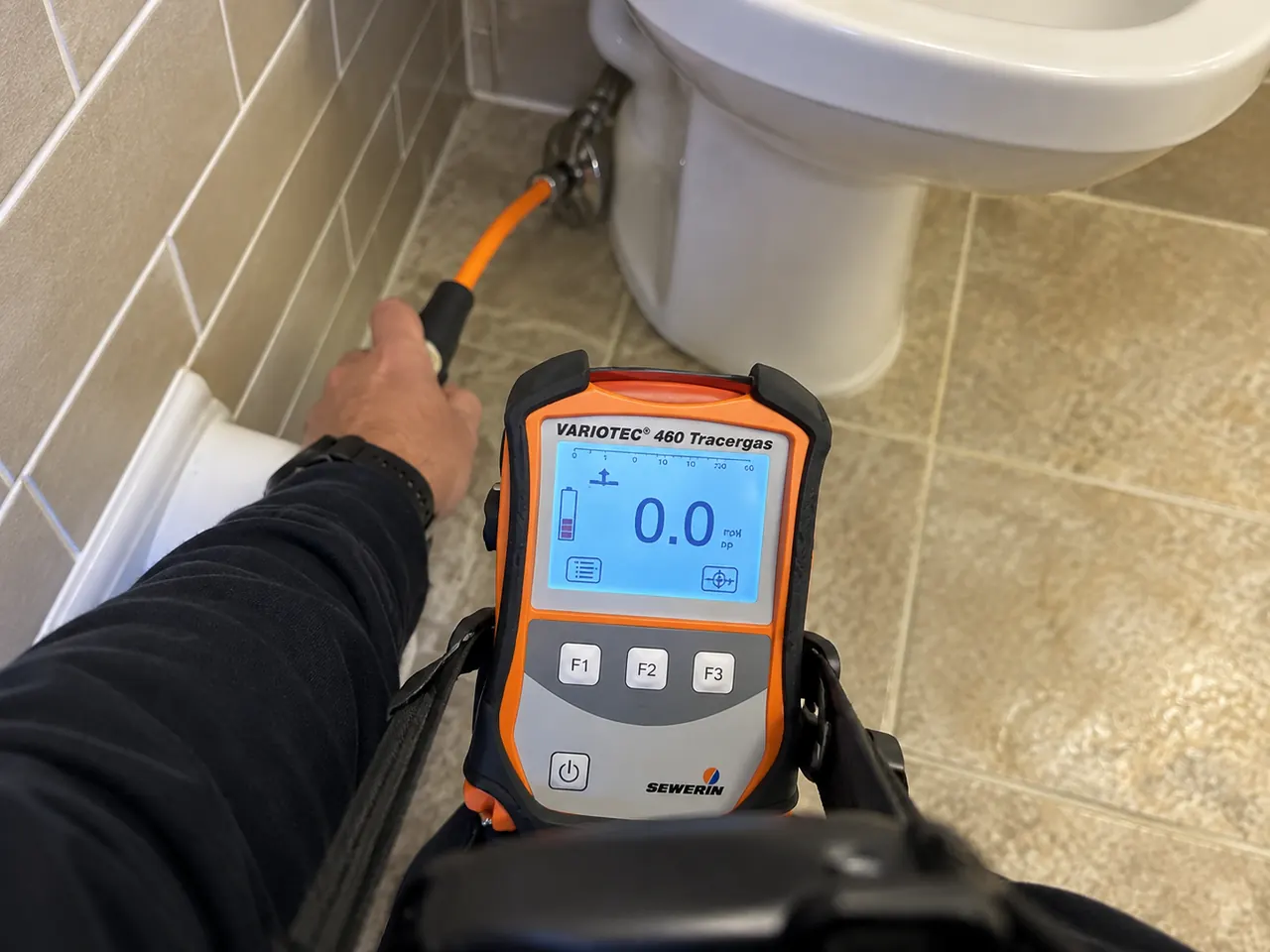
- Tracer gas is used on drained lines when the leak is too quiet or too deep to hear.
- Moisture meters map how far water has travelled through drywall, baseboards and subfloor.
What happens during a water leak detection visit
- Questions firstWhen it started, which rooms, the bill history, and whether you've tried the meter test.
- Confirm the leakMeter and pressure readings confirm water loss and show how fast it's happening.
- IsolateFixture shutoffs and the main valve separate fixtures, hot and cold sides, and inside from outside.
- LocateThe leaking section is pinpointed with the appropriate method and marked.
- ExplainYou get the location, the likely cause and what the repair involves.
When to call for water leak detection
Call when the meter test shows water loss, when a damp area keeps coming back after you dry it, or when you can hear water with nothing running. If water is actively spreading, close the main shutoff first. If the leak turns out to be under the concrete, the next step is slab leak detection.
Frequently asked questions
How do I know if I have a water leak in my house?
Turn off all water use and watch the meter for 15 to 30 minutes. If the leak indicator moves, water is escaping. Close the house shutoff valve and watch again: if the meter stops, the leak is inside the house.
Can a small drip really raise my water bill?
Yes. The City of Mansfield cites EPA figures that a faucet dripping once per second can waste more than 3,000 gallons a year, and a leaky toilet flapper up to 950 gallons a week.
Is water leak detection the same as plumbing leak detection?
For a home, yes. Both mean locating where water escapes from the supply plumbing: pipes, valves, fittings and fixture connections. This page covers general household leaks. Leaks under the slab, in the yard or in irrigation have their own pages because they're found differently.
Will you need to cut into my walls?
Not to find the leak. Pressure, acoustic, thermal, tracer gas and moisture testing all work from the surface. An opening is only needed for the repair, at the marked spot.
What if the leak is in a fixture rather than a pipe?
Then it's usually a straightforward repair, such as a flapper, fill valve, supply line or cartridge. Identifying that early stops anyone chasing a pipe leak that doesn't exist.
Should I turn off the water while I wait?
If water is actively spreading, yes: close the main house shutoff. If it's a slow leak, leave the water on until the visit so the leak can be confirmed and traced while the system is under pressure.
Related leak detection services
- Hidden Water Leak DetectionConcealed leaks behind finishes: musty smells, damp patches, water loss with no visible source.View service
- Ceiling & Wall Leak DetectionWater stains, bubbling paint, soft drywall and wet baseboards traced back to the pipe.View service
- Slab Leak DetectionSupply-line leaks under a concrete slab foundation: warm floor spots, running-water sounds.View service
- Water Meter & High Water Bill Leak DetectionUnexplained high bills and a meter that moves with everything off, traced to the source.View service
- Water Service Line Leak DetectionThe private line from the city meter to your house: pressure loss, soggy yard, meter spinning.View service
- All leak detection in MansfieldEvery leak type we locate, and a symptom matcher to find yours.Go to homepage
Get the leak located before anything gets opened up
Call and describe what you're seeing, or send the short form at the top of this page. You'll get a clear next step either way.
- Have a recent water bill handy
- Note when you first noticed it
- Water spreading? Close the house valve first