
Leak detection specialists in Mansfield, Texas
Professional Leak Detection in Mansfield, TX
Suspect a leak but can't find it? We locate water leaks in Mansfield homes and businesses, under slabs, inside walls and ceilings, beneath the yard and between the meter and the house, so the repair starts in the right place.
- Locate first, open only where needed
- Homes and commercial properties
- Throughout Mansfield, TX
- 1Call or send the form
- 2We locate the leak
- 3You get the spot & repair options
- Non-invasive methodsAcoustic, thermal, tracer gas, pressure and moisture testing from the surface.
- Inside and outsideSlabs, walls, ceilings, yards, service lines, irrigation and pools.
- Clear findingsThe exact spot, the likely cause and the repair options, explained.
- Mansfield focusedLocal water service, soils and neighborhoods, nothing else.
What are you noticing?
Pick the sign closest to what's happening at your property. The diagram shows where that kind of leak usually sits, and the link takes you to the page that explains how it's found.
Water meter & high water bill
Water is passing the meter somewhere. A meter test splits the problem in two: inside the house, or on the line and irrigation outside it.
Leak detection services in Mansfield
Every leak lives somewhere specific. Each service covers one of those places, the signs it gives off and how it's located.
- Inside the homeWater Leak DetectionLeaks in household supply pipes, fixtures and fittings: dripping, damp cabinets, wet floors.View service
- Inside the homeHidden Water Leak DetectionConcealed leaks behind finishes: musty smells, damp patches, water loss with no visible source.View service
- Inside the homeCeiling & Wall Leak DetectionWater stains, bubbling paint, soft drywall and wet baseboards traced back to the pipe.View service
- Inside the homeSlab Leak DetectionSupply-line leaks under a concrete slab foundation: warm floor spots, running-water sounds.View service
- Inside the homeCrawl Space Leak DetectionPier-and-beam homes: pipe leaks under the floor, damp crawl spaces, sagging insulation.View service
- Outside & undergroundUnderground Water Leak DetectionBuried pipe leaks under lawns, driveways and landscaping, located before anyone digs.View service
- Outside & undergroundWater Service Line Leak DetectionThe private line from the city meter to your house: pressure loss, soggy yard, meter spinning.View service
- Outside & undergroundWater Meter & High Water Bill Leak DetectionUnexplained high bills and a meter that moves with everything off, traced to the source.View service
- Outside & undergroundIrrigation & Sprinkler Leak DetectionSprinkler mainlines, zone valves and laterals leaking underground or between cycles.View service
- Outside & undergroundPool & Spa Leak DetectionWater loss beyond evaporation: pool plumbing, skimmers, returns, main drains and spas.View service
- CommercialCommercial Leak DetectionOffices, retail, warehouses and multi-unit properties: water-loss investigation and leak location.View service
- Not sure which one you need?Match your symptom on the diagram, or call and describe what you're seeing.
Signs you may have a hidden water leak
The water itself is usually hidden under concrete, behind drywall or below the lawn. What you notice first is a side effect.
- A higher bill
Usage up with no change in habits, guests or watering.
- A moving meter
The leak indicator turns with every tap and appliance off.
- Running-water sounds
Hissing or rushing in walls or floors when nothing is on.
- Warm or damp floors
Flooring that's warm, cupped, lifting or stained.
- Musty smells
Odor in a closet, cabinet or room with no visible water.
- Pressure loss
Weaker flow across the house, not just one fixture.
- Wet ground
A soggy, sunken or extra-green strip that doesn't dry out.
- New stains
Ceiling marks, bubbling paint or swollen baseboards.
Do the 15-minute meter test before you call
It tells you, and us, whether the leak is inside the house or outside it.
- Turn everything offFaucets, ice maker, washer and the irrigation controller.
- Watch the meterIn the box near the curb, usually in line with an outdoor faucet. Lift the lid with a screwdriver.
- Wait and re-checkIf the reading or leak indicator moved, water is leaving the system.
- Close the house valveStill moving: the leak is outside. Stopped: it's inside the house.
Why accurate leak detection matters
Finding the general area of a leak is easy. Finding the exact spot is what saves money. A slab leak located to a small area means one access point instead of trenching a kitchen. A service line leak marked on the lawn means one hole instead of a dug-up yard.
Many North Texas homes also sit on post-tensioned slabs containing steel cables under high tension. Nobody should cut into one on a guess.
- Your finishesTile, hardwood and cabinets only get opened at the leak.
- Your water billEvery day a leak runs is billed, now on five rate tiers.
- Your foundationLeak water changes soil moisture, and North Texas clay reacts to it.
- Your insurance claimA documented location and cause is what adjusters ask for.
How professional leak detection works
Confirm there's a leak, narrow it to one part of the system, then pinpoint it with the method that suits that part.
- Initial assessmentWhat you've noticed, when it started, bill history and the plumbing layout.
- Confirm water lossMeter and pressure readings show whether water is leaving the system, and how fast.
- Isolate the systemHouse vs service line and irrigation, hot vs cold, until the leaking section is known.
- Choose the methodAcoustic, thermal, tracer gas, pressure or moisture, depending on what covers the pipe.
- Pinpoint the locationNarrowed to a marked spot on the floor, wall, ceiling or ground.
- Explain the next stepLocation, likely cause and realistic repair options.
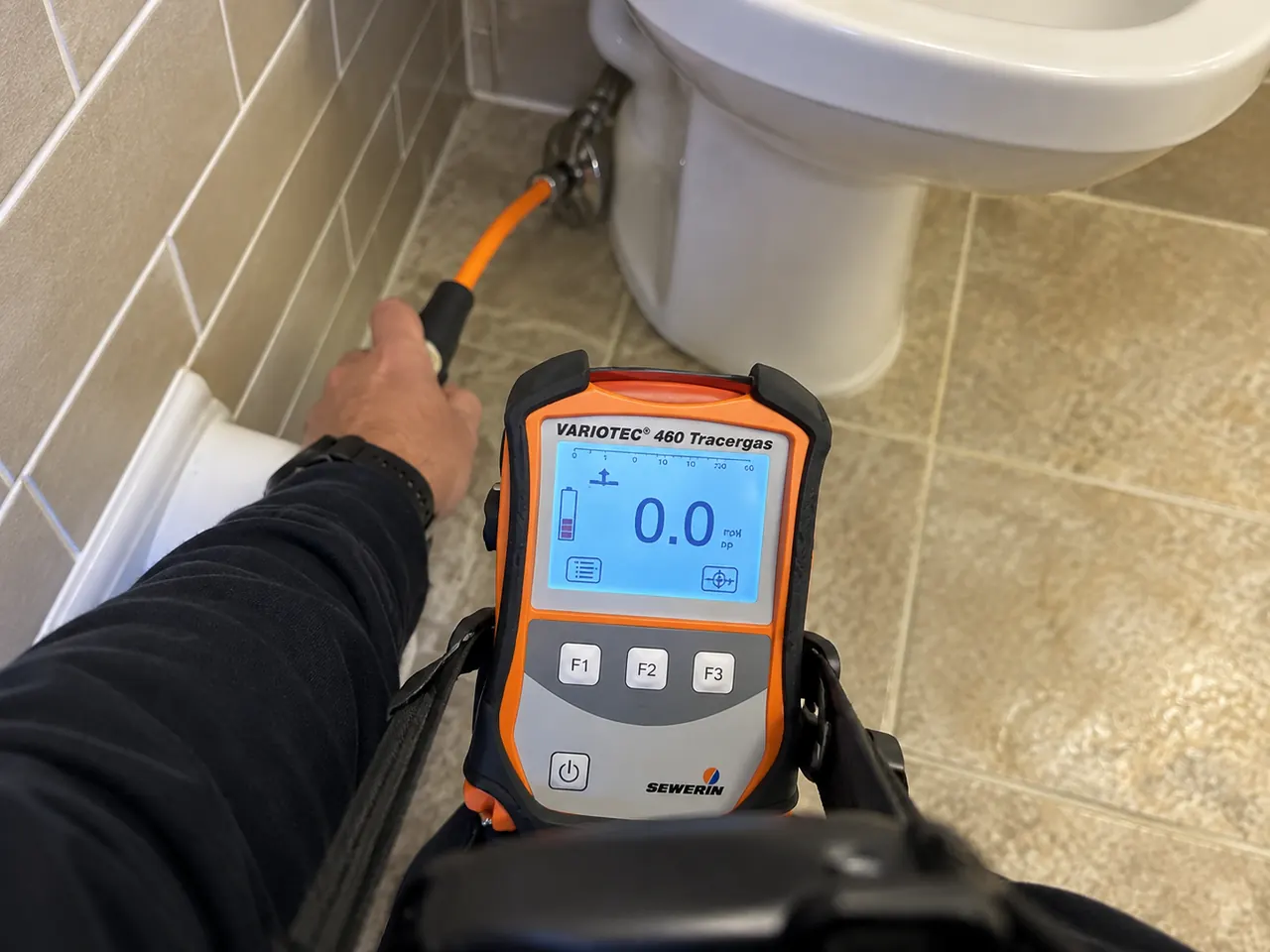
Leak detection methods, and when each one is used
No single tool finds every leak. The right one depends on what the pipe is buried in and whether it carries hot or cold water.
- Acoustic leak detection
Pressurized water escaping a pipe makes noise. Ground microphones follow it to where it's loudest. For underground, slab, service lines
- Thermal imaging
Infrared cameras show temperature differences through floors, walls and ceilings. For slab, hidden, ceiling & wall
- Tracer gas
A safe gas mix in a drained line escapes at the leak and is detected at the surface. For hidden, slab, underground
- Pressure testing
Sections are isolated and watched on a gauge. The one that won't hold pressure leaks. For water leaks, service lines, pools
- Moisture detection
Moisture meters map damp drywall, subfloor and framing back toward the source. For ceiling & wall, crawl space, hidden
- Pipe locating
Line tracers and sondes map where a buried pipe really runs before anyone listens or digs. For service lines, irrigation, underground
Leak detection in Mansfield: what's useful to know locally
How water service works in Mansfield changes what you should do when you suspect a leak.
- The meter is the city's. The line to your house is yours.
The City of Mansfield owns the meter. Report a leak at the meter, a city main break or no water to Mansfield Water Utilities: 817-276-4230 (weekdays 8 a.m.–5 p.m.) or 817-473-8411 after hours. Leaks from the meter to the house are the owner's to find and fix.
- New water rates from October 1, 2026
Residential customers moved from three rate tiers to five. A leak adding thousands of gallons a month can push a household into higher-priced tiers, so it costs more than it used to.
- WaterSmart shows continuous use
Register for the city's free WaterSmart portal with the account number on your bill. Use that never drops to zero overnight is a strong hint of a leak.
- Ask about leak forgiveness
The city has a Leak Forgiveness Form. Eligibility is set by the city: ask Utility Billing at 817-276-4230 and keep records of where the leak was found and when it was fixed.
- Clay soil and slab foundations
Expansive clay is common across Dallas–Fort Worth, and slab-on-grade foundations are standard in North Texas. Soil movement stresses pipes, and a leak changes the soil under the house.
- Irrigation hours help spot leaks
Mansfield prohibits irrigation-system watering from 10 a.m. to 6 p.m., year-round. A zone running or wet in that window points to a stuck valve or leak.
Sources: City of Mansfield Water Utilities pages on water emergencies, rate changes, WaterSmart and watering restrictions.
Serving Mansfield, Texas
Mansfield spans Tarrant, Johnson and Ellis counties, from 1970s homes around Walnut Creek Country Club to new construction in the south. Plumbing ages differently in each, so leak patterns differ too.
Leak detection in Mansfield: frequently asked questions
How much does leak detection cost in Mansfield?
It depends on what has to be tested. A single fixture area or a clear meter-test result is quicker to work through than a slab leak on a large home or a service line under a long driveway. The main cost factors are the type of leak, how many lines need isolating and testing, access, and the size of the property. Call with what you're seeing and you'll get a clear explanation of what the visit involves before it's booked.
Do walls or floors have to be opened to find a leak?
Not to find it. Leak detection uses meter checks, pressure isolation, acoustic listening, thermal imaging, tracer gas and moisture readings from the surface. The goal is that the only opening made is the one needed for the repair, at the marked spot, instead of exploratory holes.
How do I know if I have a slab leak?
Common signs are a warm or damp area on the floor, the sound of running water with everything off, cracked or lifting flooring, and a meter that moves when no water is in use. A meter test plus isolating the hot and cold sides confirms whether the leak is under the slab before anyone looks for the exact spot. See slab leak detection.
What are the signs of a leaking water line outside?
A wet or unusually green strip of lawn, a soggy spot that never dries, a drop in pressure throughout the house, and a meter that keeps moving with the house shutoff closed. That last test is the clearest one. See water service line leak detection.
Who is responsible for a leak at or near my water meter?
The City of Mansfield owns and maintains the water meter. A leak at the meter itself, a broken city main or a loss of service should be reported to Mansfield Water Utilities at 817-276-4230 during business hours or 817-473-8411 after hours. The pipe from the meter to your home is the property owner's, so leaks on that line are yours to locate and repair.
Can I check for a leak myself before calling?
Yes. Turn off every faucet, appliance and the irrigation system, then watch the meter's leak indicator for 15 to 30 minutes. If it moves, water is leaving somewhere. Then close the house shutoff valve: if the meter still moves, the leak is outside between the meter and the house; if it stops, it's inside. Our water meter leak page walks through it.
Will my homeowners insurance cover the leak?
It depends on your policy and the cause. Many policies treat sudden water damage and the cost of accessing a pipe differently from the pipe repair itself, and long-term seepage is often excluded. A clearly documented leak location and cause makes the conversation with your insurer much easier. Check your policy wording before repairs begin.
How soon can someone come out?
That depends on the schedule on the day you call and how urgent the situation is. If water is actively spreading, shut off the house valve first, then call (817) 753-1911 and say so. Use the request form for problems that can wait a few days.
Get the leak located before anything gets opened up
Call and describe what you're seeing, or send the short form at the top of this page. You'll get a clear next step either way.
- Have a recent water bill handy
- Note when you first noticed it
- Water spreading? Close the house valve first